Chuck eye steak: what it is and its names in six systems
The rib eye muscle where it runs forward into the chuck, over ribs 1 to 5. Same muscle as a rib eye or scotch fillet, from the shoulder end.
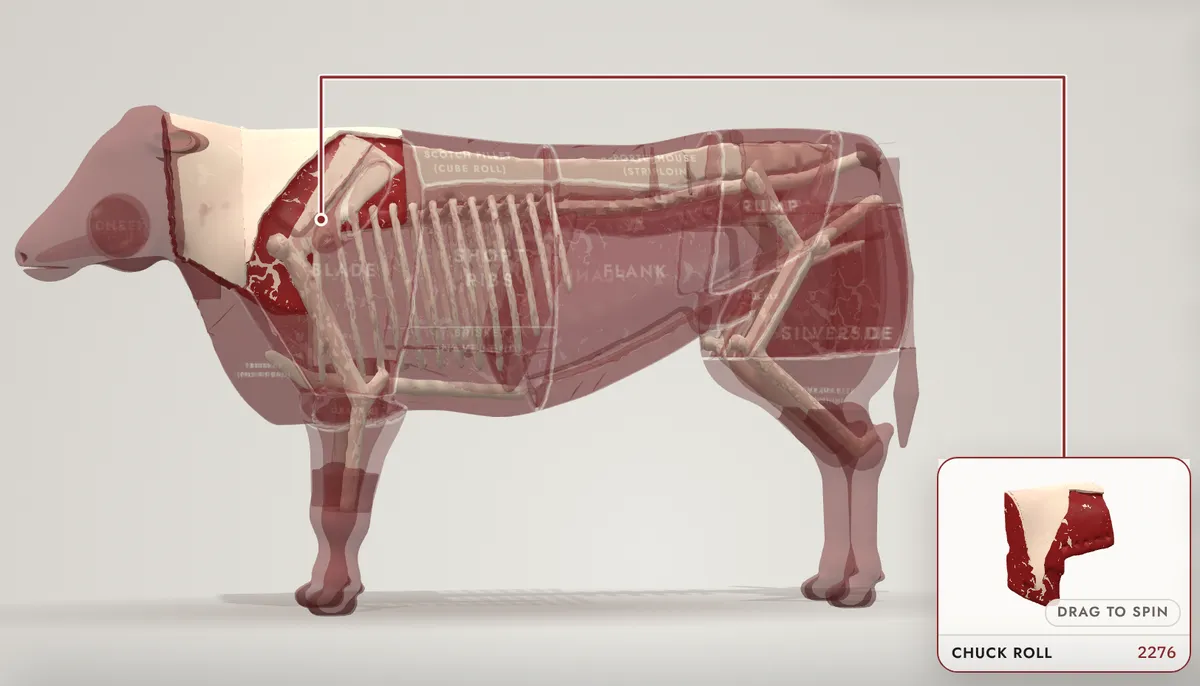
All six systemsM. longissimus, chuck end (ribs 1–5) · trade names and codes
- USUnited States
- Chuck eye roll (NAMP 116D); chuck eye (Delmonico) steak
- UKUnited Kingdom
- Chuck eye; rib eye fillet (its continuation in the chuck)
- AUAustralia
- Chuck eye steak approx.
Trade: Chuck eye roll / chuck eye log (HAM 2268 / 2264; within Chuck roll 2275) - 日Japan (yakiniku)
- 肩ロース芯 かたロースしん kata-rōsu shin
- 한Korea (BBQ)
- 윗등심살 witdeungsimsal
- 中Hong Kong (Cantonese)
- 下肩胛眼肉捲 (梅花) (trade name); 牛肩胛 (chuck roll) approx.
Same muscle as the rib eye, from the shoulder end.
Still being checked: Cantonese 牛肩胛 covers the whole chuck roll. 牛頸脊 moved to the neck record (CC-03).
FQ-15Each system cuts the carcase into different primals. Tap one to see that system's chart on the 3D steer. (part) = a straight line splits this piece between two primals.
How to ask a butcherWhat to say in each country
Ask for steaks from the end of the chuck roll nearest the ribs: they are the closest to a rib eye.
Show the butcher the name for their country. Codes: HAM = AUS-MEAT item number, NAMP = US Meat Buyer's Guide number.
Cut it and cook it at homeGrill ✓ · Roast ✓ · Braise ✓ · Hot pot ✓ · KBBQ ✓
- Look for the round eye of meat in the middle of the steak; the more eye, the more rib-eye-like.
- Trim the chewier muscles around the eye for mince or a braise.
Like a rib eye, a little chewier and cheaper.
The whole chuck eye roll roasts well.
Marbled enough to stay moist in a long braise.
Shaved thin it has enough fat to stay tender.
肩ロース芯 and 윗등심살 are grilling cuts.
Works; shin gives more body.
Cooking ratings are the atlas's own, from the fat, grain and connective tissue of the cut.
Name traps'Delmonico' means several steaks · Rib eye vs scotch fillet
In the US the name is used for more than one steak. Ask which muscle it is.
The Australian naming flip for the same muscle further back.
Sources14 sources for the names
- S1 · AUS-MEAT Ltd, AUS-MEAT, Handbook of Australian Meat database — individual cut code sheets
- S2 · AUS-MEAT / MLA Japan, Handbook of Australian Meat, 7th ed., Japanese edition — boneless beef, offal and variety items indexes
- S3 · Meat & Livestock Australia (australianbeef.com.au), Beef cuts (consumer guide)
- S4 · Meat & Livestock Australia, MSA beef primal and sub-primal cuts poster (2018)
- S5 · AHDB Beef & Lamb (UK), Meat Purchasing Guide, 8th edition (March 2019)
- S8 · Beef Checkoff (via thefair.org), Beef Cuts for Foodservice chart (2021)
- S9 · Toyonishi Farm (トヨニシファーム), Hokkaido, 牛肉3D部位解説 (Beef 3D part commentary)
- S12 · Gyeongsangnam-do Agricultural Research & Extension Services, 소 도체의 대·소분할 부위별 정형 (official primal and subprimal definitions)
- S19 · JC in UK blog, 英國買牛肉全攻略 (Cantonese–English cut table)
- S20 · Wagyu Wholesale Ltd (Hong Kong), 和牛食用部位
- S21 · DRFS (Hong Kong), 日本和牛的不同部位
- S39 · Certified Angus Beef Hong Kong, 牛肉部位 (beef cuts list)
- S51 · United Nations Economic Commission for Europe, UNECE Standard: Bovine Meat Carcases and Cuts, 2004 edition (ECE/TRADE/326)
- S52 · US Meat Export Federation (USMEF) Japan, アメリカン・ミート ニュー・カットガイド (American Meat New Cut Guide), May 2015
Names come from the atlas's muscle table (record FQ-15, LR-01); an approx. tag marks an approximate match, or one still being checked. The model picture is a screenshot of the atlas's own 3D model, not a photo.