Oyster blade: what it is and its names in six systems
Also written: Oyster blade steak
Oyster blade is the Australian name for the oyster blade: a small, tender shoulder muscle with a gristle line down the middle (US top blade, UK feather blade). With the gristle cut out it becomes flat iron steak.
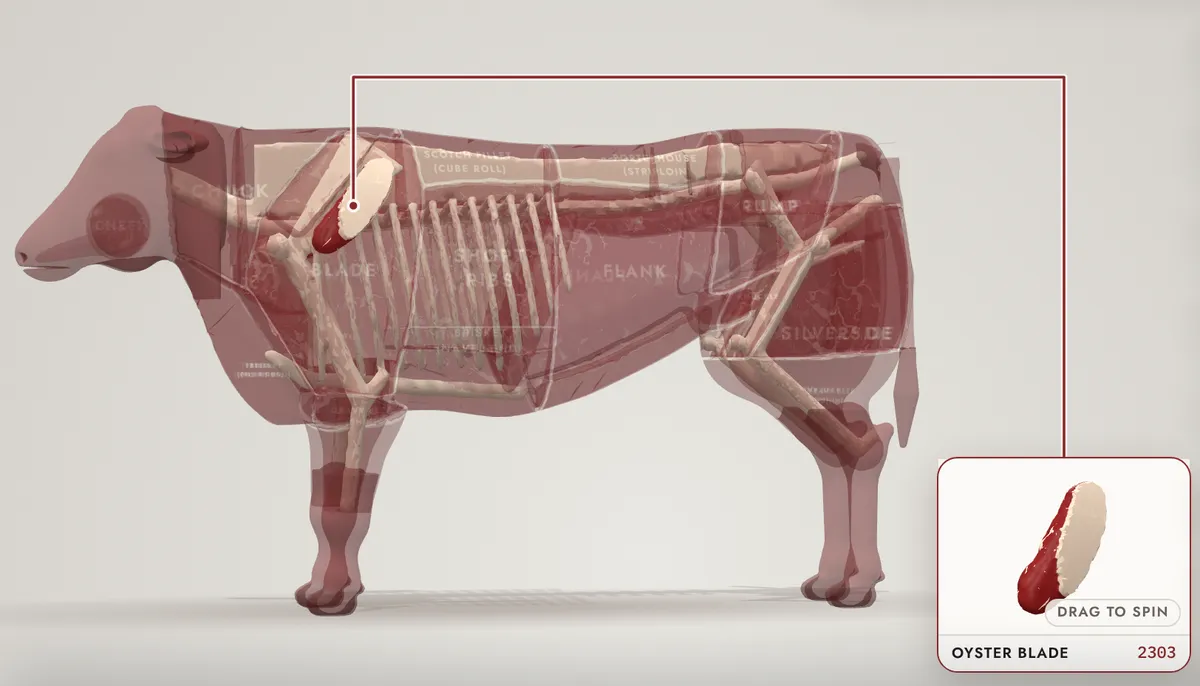
All six systemsM. infraspinatus · trade names and codes
- USUnited States
- Top blade; flat iron steak (NAMP 114D)
- UKUnited Kingdom
- Feather (feather blade); flat iron steak
- AUAustralia
- Oyster blade steak; Flat iron steak (when fully trimmed)
Trade: Oyster blade (HAM 2303; alt. Top blade) - 日Japan (yakiniku)
- ミスジ misuji
- 한Korea (BBQ)
- 부채살 buchaesal
- 中Hong Kong (Cantonese)
- 牛板腱
Same muscle as UK feather / US flat iron. HAM 2303 also carries a thin layer of M. trapezius. The central gristle line is removed to make flat iron.
FQ-01Each system cuts the carcase into different primals. Tap one to see that system's chart on the 3D steer. (part) = a straight line splits this piece between two primals.
How to ask a butcherWhat to say in each country
Show the butcher the name for their country. Codes: HAM = AUS-MEAT item number, NAMP = US Meat Buyer's Guide number.
Cut it and cook it at homeBraise ✓ · Hot pot ✓ · KBBQ ✓
- Find the gristle line on the cut face: it runs the whole length of the muscle.
- For yakiniku, slice thin across the grain; each slice keeps a small piece of gristle in the middle.
- For grilling as steaks, split it along the gristle into two flat iron steaks (see Flat iron).
- For braising, leave it whole or in thick steaks; the gristle melts.
Tender and full-flavoured, but the gristle line stays chewy in a thick steak. Thin slices or flat iron steaks grill well.
Slow-roasted whole, the gristle softens; a hot, fast roast leaves it chewy.
The gristle turns gelatinous and the meat stays moist: a classic Australian slow-cook cut.
Shaved thin across the grain, the gristle line is barely noticeable.
As ミスジ and 부채살 it is a well-known grilling cut, sliced thin and seared briefly.
Works, but shin or brisket give a deeper broth for less money.
Cooking ratings are the atlas's own, from the fat, grain and connective tissue of the cut.
Sources9 sources for the names
- S1 · AUS-MEAT Ltd, AUS-MEAT, Handbook of Australian Meat database — individual cut code sheets
- S3 · Meat & Livestock Australia (australianbeef.com.au), Beef cuts (consumer guide)
- S5 · AHDB Beef & Lamb (UK), Meat Purchasing Guide, 8th edition (March 2019)
- S9 · Toyonishi Farm (トヨニシファーム), Hokkaido, 牛肉3D部位解説 (Beef 3D part commentary)
- S11 · Hiroshi Takahashi, note.com, 焼肉部位解説② みすじ・とうがらし
- S12 · Gyeongsangnam-do Agricultural Research & Extension Services, 소 도체의 대·소분할 부위별 정형 (official primal and subprimal definitions)
- S20 · Wagyu Wholesale Ltd (Hong Kong), 和牛食用部位
- S51 · United Nations Economic Commission for Europe, UNECE Standard: Bovine Meat Carcases and Cuts, 2004 edition (ECE/TRADE/326)
- S52 · US Meat Export Federation (USMEF) Japan, アメリカン・ミート ニュー・カットガイド (American Meat New Cut Guide), May 2015
Names come from the atlas's muscle table (record FQ-01); an approx. tag marks an approximate match, or one still being checked. The model picture is a screenshot of the atlas's own 3D model, not a photo.