Tri-tip: what it is and its names in six systems
A small triangular muscle at the bottom of the rump. Australians call it tri-tip or rump tail (HAM 2131); in Japan it is トモサンカク, in Korea 삼각살.
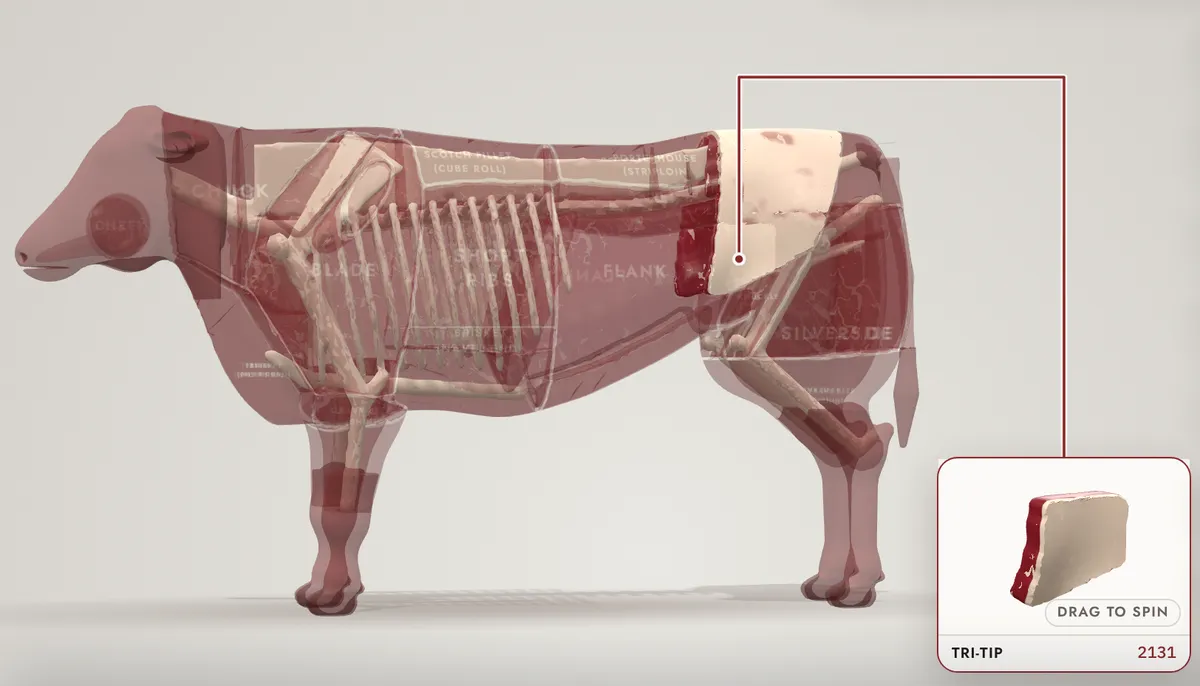
All six systemsM. tensor fasciae latae · trade names and codes
- USUnited States
- Tri-tip (NAMP 185D)
- UKUnited Kingdom
- Rump tail; tri-tip
- AUAustralia
- Tri-tip
Trade: Tri tip (HAM 2131; alt. Bottom sirloin triangle / Rump tail) - 日Japan (yakiniku)
- トモサンカク tomosankaku; ヒウチ hiuchi
- 한Korea (BBQ)
- 삼각살 samgaksal
- 中Hong Kong (Cantonese)
- 三角肉 (trade name)
It is also the cap muscle removed when the AU knuckle (HAM 2070) is prepared.
HQ-05Each system cuts the carcase into different primals. Tap one to see that system's chart on the 3D steer. (part) = a straight line splits this piece between two primals.
How to ask a butcherWhat to say in each country
In Australia it is often left on the rump or taken off with the knuckle trim. Ask the butcher to keep it whole.
Show the butcher the name for their country. Codes: HAM = AUS-MEAT item number, NAMP = US Meat Buyer's Guide number.
Cut it and cook it at homeGrill ✓ · Roast ✓ · KBBQ ✓ · Soup ✗
- The grain runs in two directions, fanning out from the corner.
- After cooking, cut the roast in two where the grain changes, then slice each half across its own grain.
Grilled whole over medium heat, then sliced.
Roasted whole; small enough to cook quickly.
Works, but it is a roasting and grilling cut.
Shaved thin across the grain it works; not a usual hot-pot cut.
Sold as トモサンカク (also ヒウチ) for yakiniku and as 삼각살 in Korea.
Too lean for broth.
Cooking ratings are the atlas's own, from the fat, grain and connective tissue of the cut.
Name trapsJapan files it with the knuckle · US 'bottom sirloin'
Japanese butchery puts the tri-tip with the knuckle, not with the rump as Australia and the UK do.
In US trade the tri-tip is part of the bottom sirloin, which is in the Australian rump, not the Australian sirloin.
Sources7 sources for the names
- S1 · AUS-MEAT Ltd, AUS-MEAT, Handbook of Australian Meat database — individual cut code sheets
- S5 · AHDB Beef & Lamb (UK), Meat Purchasing Guide, 8th edition (March 2019)
- S9 · Toyonishi Farm (トヨニシファーム), Hokkaido, 牛肉3D部位解説 (Beef 3D part commentary)
- S12 · Gyeongsangnam-do Agricultural Research & Extension Services, 소 도체의 대·소분할 부위별 정형 (official primal and subprimal definitions)
- S39 · Certified Angus Beef Hong Kong, 牛肉部位 (beef cuts list)
- S51 · United Nations Economic Commission for Europe, UNECE Standard: Bovine Meat Carcases and Cuts, 2004 edition (ECE/TRADE/326)
- S52 · US Meat Export Federation (USMEF) Japan, アメリカン・ミート ニュー・カットガイド (American Meat New Cut Guide), May 2015
Names come from the atlas's muscle table (record HQ-05, ); an approx. tag marks an approximate match, or one still being checked. The model picture is a screenshot of the atlas's own 3D model, not a photo.